
Dividends Matter More Than You Think

When I first started investing, I thought about returns in the same way most people do.
I bought a stock at one price and hoped that, over time, someone would be willing to pay me a higher price for it. If the share price went up, the investment was successful. If it went down, it was not.
The logic seemed straightforward.
Only later did I begin to appreciate that a rising share price is just one part of the return an investor can earn. A stock is not simply a piece of paper whose value moves up and down on a screen. It represents an ownership interest in a real business, a business that generates revenue, earns profits, reinvests capital and, in many cases, distributes a portion of its earnings to its owners.
Those distributions are dividends.
At first, dividends can appear almost insignificant. A payment of 2% or 3% a year does not create the same excitement as a stock rising 30% in a matter of months. A dividend arrives quietly, often without attracting much attention.
A Small Payment That Buys More Ownership
Imagine owning shares in a business that pays you a dividend every year.
You could withdraw that cash and spend it. There is nothing inherently wrong with doing so, particularly for an investor who depends on portfolio income to finance living expenses.
But an investor who is still in the accumulation stage has another option: use the dividend to buy additional shares.
Those additional shares will then participate in future earnings and receive their own dividends. When the next dividend is paid, the investor owns slightly more of the company and therefore receives slightly more cash.
That larger payment can be used to buy still more shares.
Figure 1: The Dividend Reinvestment Flywheel: How Cash Distributions Build Greater Ownership Over Time

The process repeats itself:
The company pays a dividend.
The dividend buys additional shares.
The additional shares generate additional dividends.
Those dividends buy even more shares.
The Difference Becomes Visible Over Decades
A long-term illustration demonstrates the scale of this effect.
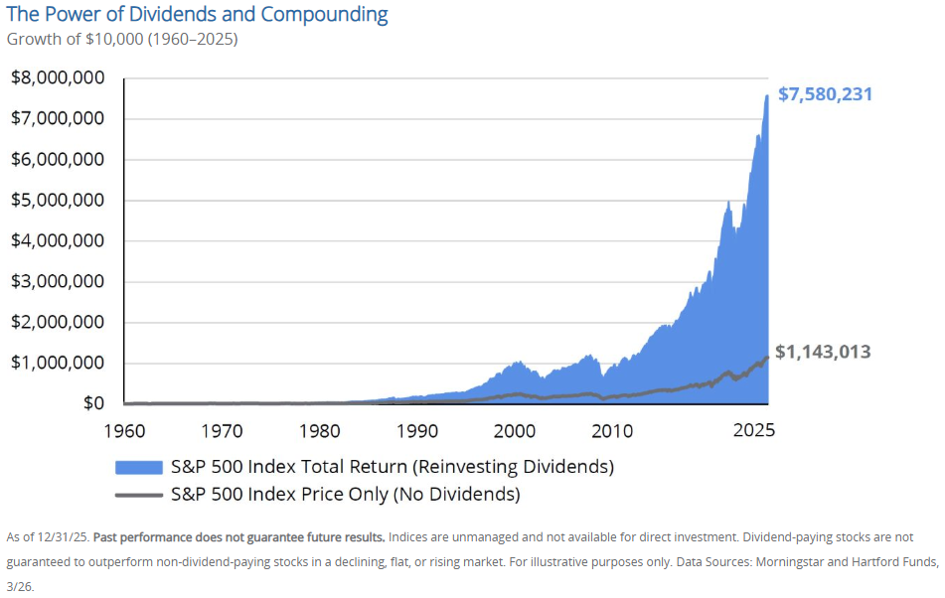
Figure 2: The Power of Dividends and Compounding: Growth of $10,000 Invested in the S&P 500, 1960–2025
Source: Morningstar and Hartford Funds. Data as of December 31, 2025.
According to data from Morningstar and Hartford Funds, $10,000 invested in the S&P 500 at the beginning of 1960 would have grown to approximately $7.58 million by the end of 2025 if dividends had been reinvested. By comparison, the increase in the index price alone would have produced a value of approximately $1.14 million.
The enormous difference was not created by predicting recessions, identifying the perfect moment to enter the market or using leverage. It came from repeatedly reinvesting the cash generated by the underlying businesses and giving that process enough time to compound.
The investor did not need to make a brilliant decision every year.
The investor mostly needed to avoid interrupting the process.
Dividends Are Only Part of the Equation
The lesson is not that every investor should search for the highest dividend yield. A dividend is valuable only when it is supported by a healthy business. If a company pays out more cash than it can sustainably generate, the dividend may eventually be reduced. A high yield can therefore be a warning sign rather than an opportunity.
The more useful questions are whether the company earns durable profits, generates real cash flow and can continue investing in its future while rewarding shareholders. Management must decide how each euro or dollar of profit can create the most value. Sometimes the best decision is to reinvest in the business. Sometimes it is to repurchase shares at an attractive price. And sometimes it is to return cash through dividends.
For an investor who is building wealth, dividends can be put back to work, either in the same company or in another attractive business. Declining share prices can even make that cash more productive, provided the underlying business remains sound, because each payment buys a larger ownership stake.
This is also how I think about dividends at Bajic Partnership. I am naturally drawn to companies that return part of their earnings to shareholders, but those payments must be supported by durable profits and sensible capital allocation. The aim is not to maximize current yield, but to own good businesses at sensible prices and allow their cash generation to work in our favor over time.
Share prices will always attract attention, but they tell only part of the story. What matters just as much is what a business earns while we own it, how wisely those earnings are used and how much value ultimately accrues to shareholders. A dividend may arrive quietly, but when reinvested with discipline, its long-term effect can be anything but small.